2824-2's standard height is H2
2836-2's standard height is H3 or H4 (different sources report this
differently) in order to accommodate the extra thickness from the
elevated date/day discs
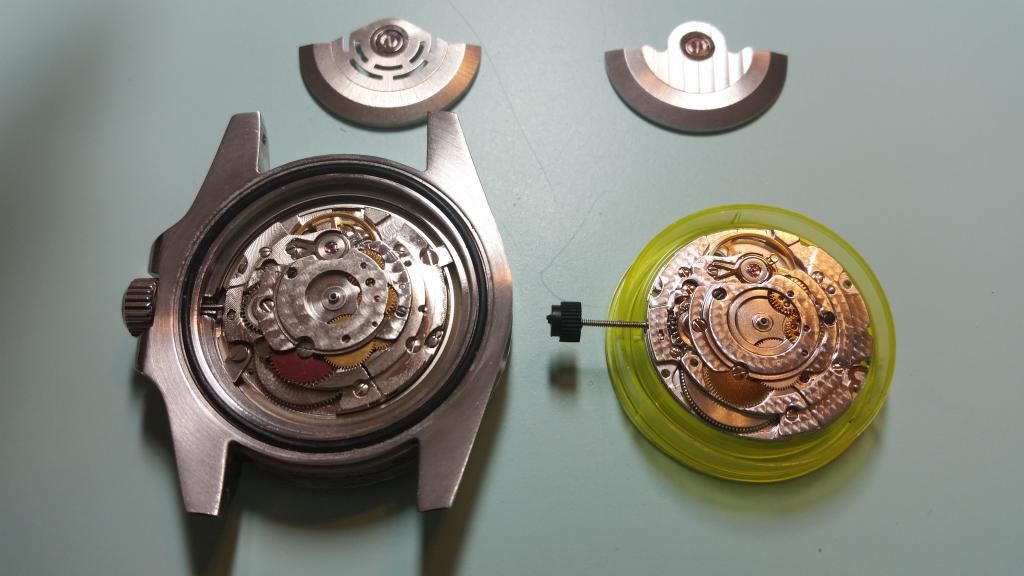
The old movement was the Z2 (2813 high beat) and the new
movement is an ETA 2824-2 clone..The hands and dial feet are are direct
swap..The crown was unscrewed from the old stem and screwed onto the new
stem for the Eta clone.
the Sea-Gull ST2100 is an excellent choice and Hangzhou 6300 also very
good. The Liaoning SL-3000 is reportly also very good. The 2824-clone
that has been reported least satisfactory has been the Shanghai Z2.
Z2,
the crown height is the same as the 2836, and .5 mm off on the 2824, so
im not 100% sure this swap will work seing as hes using the 2824
The following are known Chinese manufactured clones of the ETA 2824.
They have all been sold to 3rd party assemblers as well as used by the
house-brands of their respective manufacturers. The Sea-Gull movements
have also been used as ebauche for Swiss movements. Perhaps some of the
others have too.
This shows the evolution from the eighties-era-designed Shanghai B to
the recently-developed Z2. The movement in the middle is a kind of
improved Shanghai B.The newly-developed Z2 is indeed a very good movement, on a par with his Seagull counterpart.
parfaitement possible de brasé de l'étain sur un cable en acier. Il vous faut de la graisse de décapage qu on utilise pour les brasures a l'étain pour les tubes de cuivre. Du fil d'étain pour réalisé votre brasure Le reste est dans la technique d'application.
passez l'éxtrémitée de votre cable au papier de verre ( important il doit être bien propre et sans poussière) ne plus touché avec les doits une fois le nettoyage exécuté.
Trempé l'extrémitée du cable dans la graisse de décapage (au plus il y en a sur l'extrémitée au mieux c'est) Faites chauffé votre fer a souder (electrique) Oui un fer a souder comme pour faire les soudures sur des composants électriques ; résistances diodes ect..
Quand votre fer est chaud appliquer du fil de brasure directement sur le bec du fer a souder évidement en petite quantitée de façon a ce que vous ayez une petite goute pendante d'étain sur le bec Prenez votre cable et passé le doucement dans la goute d'étain qui est sur le bec de votre fer a souder
Si ca ne prend pas alors préchauffé un peux l'extrémitée du cable avant d'y appliquer l'étain
Normalement y a pas de problème, apres un ou deux éssais vous devriez réusir
1. the hands of an ETA fit
2. it has four dial pin screw positions that make it suitable for both
DG2813/M8215 and ETA 2824/2836 dials, dials that have four pins actually
fit with all four of them without the need to cut any of them
3. the canon length is quite short, but the Starking watches come with
an extra thin spacer, also with four cut-outs to fit any kind of dial.
Do watch out for thick dials for this reason, especially with thick
markers.
4. the watch is about as cheap as most low beat movements in this category
5. The main spring has jewel bearings, so it has at least two more jewels as a DG2813
6. The date flip transition takes about a quarter of an hour from starting to move to actually flicking over
7. The date wheel is a bit smaller than DG2813, so beware
8. DG2813 or ETA date wheels don't fit as they're too thick, especially since the short canon.
9. the movement is 99% based upon a DG2813, but different enough to not
fit the high beat parts. At least I didn't succeed to make a swap there,
and made two attempts. I couldn't figure out why yet, checked all the
parts under the magnifiers (Mantis and HD cams with macro lenses) I
have. 1813Full dimension drawings
Features: 3-pin / calendar
Dimensions: ø26mm
Thickness: 5.18mm
The median: 2.03mm
Frequency: 28800 times per hour
Gem: Diamond 25 (25 jewels)
Movement type: automatic winding / manual winding crown
After spending a healthy couple hours rebuilding two of these movements of learned a couple things:
First, if you rearrange the letters and numbers in A2813 it spells “Satan’s illegitimate demon spawn”.
Second, after struggling through aligning the six pivots over and over -
I finally realized the dang click is constantly in the way. I ended up
using a very small piece of rodico to hold it open while I set the
bridge. Voila! I set it first shot after that. With the click not
pushing on the paw winding wheel it stood straight and made life
easier. Just be careful not to place the rodico in a way that get it
pinched and gummed in there once assembled.
Another trick is just to turn it 180° and put it back after the plate has been mounted. It works perfectly
Methods 6 and 7:
There are two main alternative methods for lubricating the pallet stones:-
1. The lubricant is applied to the stones before the lever is fitted in place in
the movement. This requires care to avoid the oil being transferred to other
components.
2. The lubrication is applied to the stones after the lever is fitted using one of
the following methods:-
a. The lubricant is applied with the lever stationary before the balance is
fitted. The oil is applied to the impulse plane of the exit stone, usually
from the top and the lever moved from side to side to advance the
teeth. When three or four escape wheel teeth have passed the process
is repeated until all the teeth have been equally and evenly lubricated.
b. The movement is turned over and the exit stone is lubricated through
the inspection hole in the main plate and the lever moved from side to
side to advance the teeth. When three or four escape wheel teeth have
passed the process is repeated until all the teeth have been equally and
evenly lubricated.
c. A small amount of the lubricant is applied to each of the escape wheel
teeth. The movement is turned over and the escape wheel teeth are
lubricated through the inspection hole in the main plate. The oiler is
charged with oil / grease and then lowered to a position that allows
the moving escape wheel teeth tips to pass through the oil/grease, one
by one, until all teeth and pallet stones have been equally and evenly
lubricated.
A little on a few of the escape wheel teeth, by the action of the watch
it will distribute the oil to the pallet pins this in turn will oil the
rest of the teeth on the escapement wheel.